
Motorized Orbit & Eclipse Simulator
Source: Stemoto Original
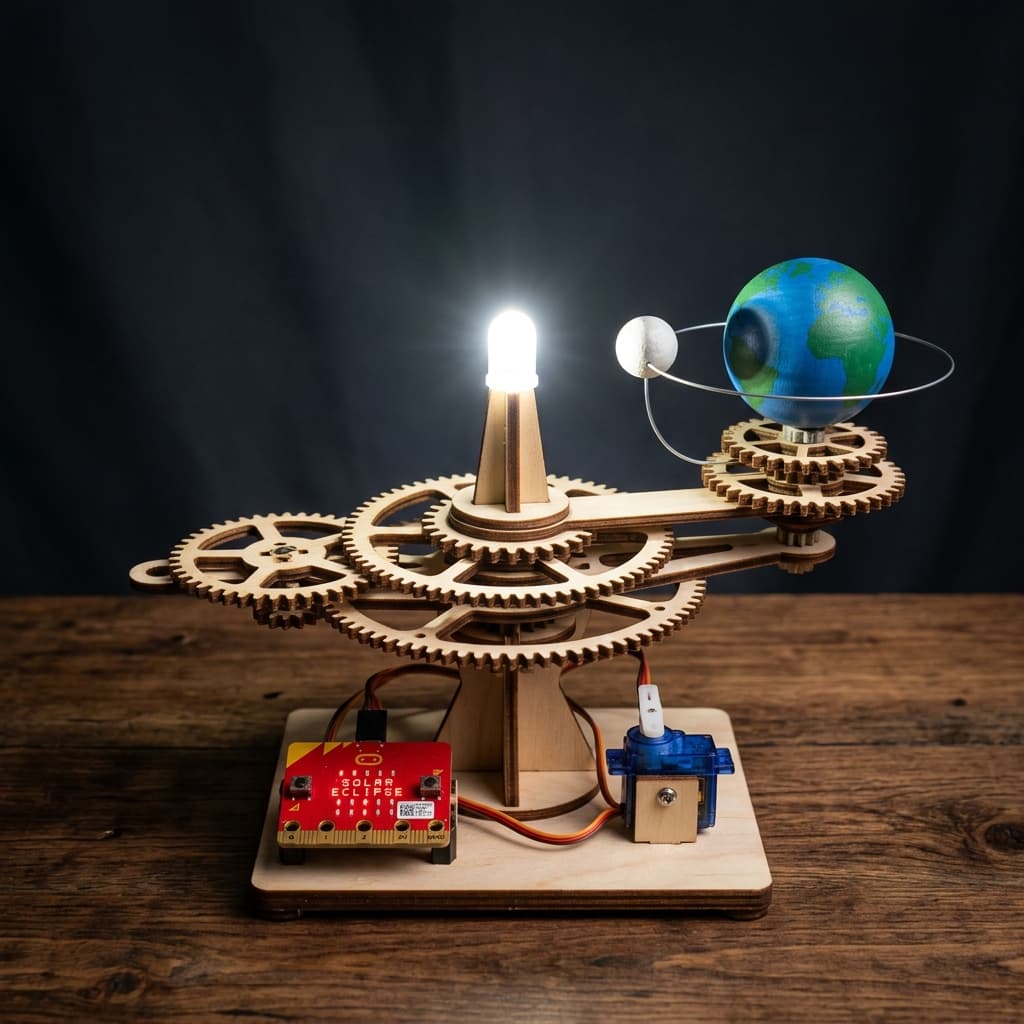
A precision-cut wooden gearbox represents the Sun-Earth-Moon mechanical relationship. A micro:bit drives the motor to demonstrate rotation vs. revolution speeds, while a central LED 'Sun' casts shadows to demonstrate how Solar and Lunar Eclipses occur.
Categorisation
Props & Materials Required
- •Precision laser-cut planetarium gearbox
- •micro:bit or servo motor
- •Mini LED light source (bright white LED)
- •Small foam or wooden balls (for Earth and Moon)
- •AA battery pack
Step-by-Step Instructions
Assemble the Gearbox
Follow the laser-cut instructions to assemble the planetary gearbox. The central post holds the LED 'Sun,' the first arm holds the 'Earth' ball, and a secondary arm off the Earth holds the 'Moon' ball.
Install the Motor
Connect the micro:bit to the servo motor that drives the main gear. Program it to rotate slowly so the Earth orbits the Sun while the Moon orbits the Earth.
Demonstrate Day and Night
Turn on the central LED Sun. As the Earth rotates on its arm, observe how one side is lit (day) and the other side is in shadow (night).
Create a Solar Eclipse
Darken the room. Slowly rotate the model until the Moon passes directly between the Sun-LED and the Earth-ball. Watch the Moon's shadow fall on Earth — that's a solar eclipse!
Create a Lunar Eclipse
Continue rotating until the Earth passes between the Sun and the Moon. The Earth's shadow darkens the Moon — that's a lunar eclipse! Discuss why eclipses don't happen every month (orbital tilt).
Why It Works & Notes
Children struggle to understand eclipses from textbook diagrams because they can't visualize three bodies moving simultaneously in 3D space. This physical model makes it viscerally clear — when the Moon passes between the Sun-LED and Earth-ball, the shadow IS the eclipse.
NEP Alignment: Spatial astronomy, physical modeling of multi-body celestial motion. Curriculum Mapping: Science (The Solar System, Earth's Movement, Solar & Lunar Eclipses). Target Level: Class 3 & 5.