
Gravity Coin Sorter & Counter
Source: Stemoto Original
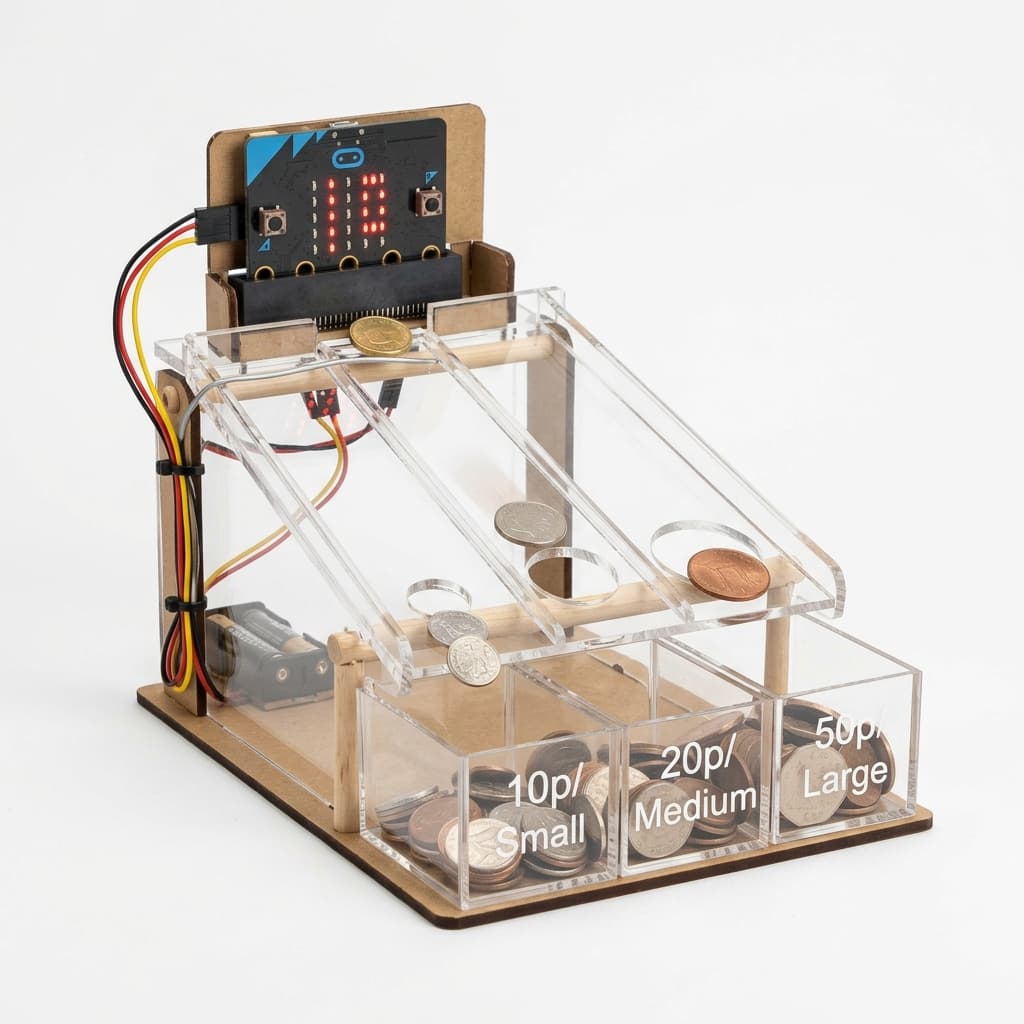
Build a gravity-fed machine where mixed play coins are dropped in and fall through size-specific holes into different bins. A micro:bit sensor counts total coins dropped, allowing students to verify their manual addition of the sorted bins.
Categorisation
Props & Materials Required
- •Laser-cut acrylic ramps with size-graded holes
- •micro:bit with light or IR sensor
- •Play coins of different sizes
- •Collection bins (small cups or boxes)
- •Cardboard housing
Step-by-Step Instructions
Build the Sorter
Assemble the laser-cut ramps at a slight angle. The ramp has holes of increasing size — small coins fall through the first hole, medium coins through the second, and large coins roll to the end.
Install the Counter
Place the micro:bit with a light sensor at the coin drop entrance. Every time a coin passes and blocks the light, the counter increments by 1.
Drop and Sort
Mix all the play coins together. Drop them one by one into the top of the sorter. Watch as gravity pulls each coin to the correct bin based on its size!
Count and Add
Count the coins in each bin manually. Small bin: 5 coins × ₹1 = ₹5. Medium bin: 3 coins × ₹2 = ₹6. Large bin: 2 coins × ₹5 = ₹10. Total = ₹21!
Verify with the Counter
Check the micro:bit counter: it should show 10 total coins (5 + 3 + 2). Does your manual addition match the sensor count? Great — you're a verified bank teller!
Why It Works & Notes
This project integrates physical engineering, fine motor skills, and foundational numeracy. Children discover that physical properties (size) can be used for automatic sorting — the same principle behind industrial sorting machines — while practicing addition with real countable objects.
NEP Alignment: Integration of physical engineering, fine motor skills, and foundational numeracy. Curriculum Mapping: Math (Money Concepts, Addition) + Science (Physical Properties). Target Level: Class 2 & 3.