
Day, Night & Earth's Rotation Theater
Source: Stemoto Original
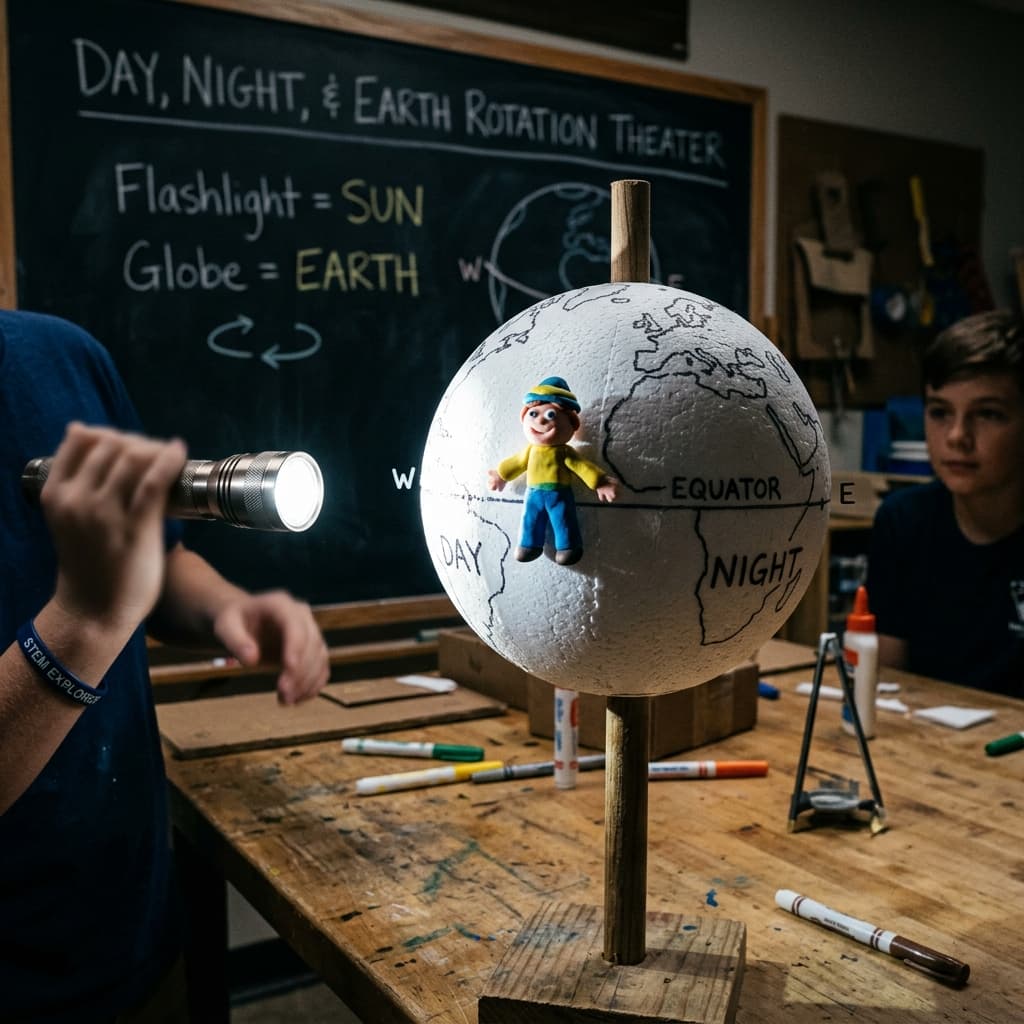
Place a Play-Doh 'person' on a Styrofoam ball (Earth). In a darkened room, one student holds a flashlight (Sun) while another slowly rotates the ball. Students observe and record how the Play-Doh person moves from light (Day) into shadow (Night).
Categorisation
Props & Materials Required
- •Flashlight or projector (as the Sun)
- •Styrofoam ball on a stick (as Earth)
- •Play-Doh (to make a tiny person)
- •Darkened room
- •Optional: second smaller ball for the Moon
Step-by-Step Instructions
Build the Earth
Stick a pencil or dowel through a Styrofoam ball. This is Earth. Roll a tiny Play-Doh person and stick them on the 'equator' of the ball. This person represents YOU!
Set Up the Sun
In a darkened room, have one student hold a flashlight (the Sun) and point it at the Styrofoam Earth from about 2 feet away.
Observe Day
Position the Earth so the Play-Doh person directly faces the flashlight. Ask: What time of day is it for our person? (Noon! The Sun is directly overhead.)
Rotate into Night
Slowly rotate the Earth on its stick. Watch the Play-Doh person move from the lit side into the shadow. Ask: What's happening now? (It's sunset... now it's night! The person can't see the Sun anymore.)
Full Rotation = One Day
Complete one full rotation. The Play-Doh person has gone through a full day-night cycle! Discuss: How long does one real rotation take? (24 hours!) Why is it light in India when it's dark in America?
Why It Works & Notes
Concrete visualization of planetary motion without needing complex mechanical models. The Play-Doh person makes it personal — 'Look, when YOU are facing the Sun, it's daytime for YOU. When Earth rotates and you face away, it becomes night.' Abstract astronomy becomes a lived experience.
NEP Alignment: Concrete visualization of planetary motion without needing complex mechanical models. Curriculum Mapping: Science (Earth, Sun, Day and Night). Target Level: Class 2 & 3.